Tuesday, 28 January 2014
The fields are now full of mole hills as the moles set off in search of mates. I wonder how they cope with the wet weather, can they drain their own runs. I saw one on the surface of the waterlogged field behind the house, sort of frantically swim-splashing uphill and disappearing into the ground. We are getting large flocks of starlings feeding up here, sometimes the gurgling sound of them all calling makes me think a pipe has burst somewhere. Driving down the lane to put the bins out I saw a tailess squirrel, it ran easily up a tree to sit and watch us in a fork of the trunk. The squirrels in the garden use their tails to signal constantly to each other, so basically its now mute. The snowdrops are out in the garden and the wild primroses have buds, though I've noticed the pheasants have taken a fancy to pecking them as they do all the new growth put out by the perennials.

Wednesday, 11 December 2013
The crows gather at sunset in the bare trees behind the house, mainly in pairs. Squabbles break out as a bid is made for someone elses partner, then all fly off at once to the roost for the night. We have been very glad to see the Long tailed tits back in the garden after the dreadful storm last week and only a few old or diseased trees came down or lost large branches.
There are still active insects around, a little bit of late afternoon sunshine brings tiny gnats out to dance in the garden and driving home the headlights often catch pale moths in their beams. We put the moth trap out last night and caught 5 Mottled Umbers in a variety of forms. The males fly from October through to January looking for the flightless females who crawl onto the trunks of deciduous trees after dark.
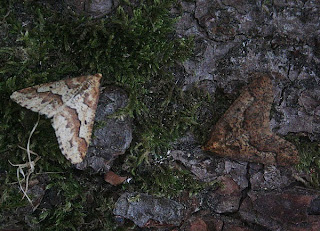
There are still active insects around, a little bit of late afternoon sunshine brings tiny gnats out to dance in the garden and driving home the headlights often catch pale moths in their beams. We put the moth trap out last night and caught 5 Mottled Umbers in a variety of forms. The males fly from October through to January looking for the flightless females who crawl onto the trunks of deciduous trees after dark.

Tuesday, 19 November 2013
First Snow
Woke up to a light dusting of snow and bright sunshine with the rich colours of the larches and beeches contrasting beautifully against the clear blue skies. Every week there seems to more bad news about the spread of tree diseases like Phytophthora ramorum and it makes me wonder what the view will be like in a few years time. In the garden we have lots of Coal Tits coming to the feeders and we are a bit worried they have become welfare dependant. We have a Robin that roosts every night in the coal shed and last night we startled a Blue Tit that was roosting in one of the outbuildings. The Robin is really cool he has discovered that if he sings in the barn the acoustics make him sound much louder than he really is and it's very pleasant to listen to as you work.


Thursday, 10 October 2013
Autumn
Its now dark at six o clock in the morning, flocks of thrushes are back feeding in the fields, the leaves are turnimg and I'm making Jam, so it must be Autumn. All the pumpkins are drying out in the conservatory, along with a wasps nest that has been in the woodshed all summer. I had to remove it with a bread-knife so its in cross-section. Some of the plums from the garden went into jam, the rest the wasps and pheasants have enjoyed. They also liked the pulp from the Rowan and Apple jellly I made- the lawn will probably sprout lots of Rowan seedlings in the spring. The woods and fields are full of fungi at the minute,I've taken some photos but not identified any , I feel a bit mean picking them for a spore print when they look so spectacular though the ones on the fallen trees behind the house are probably honey fungus. The oak trees are covered in acorns for the first time in a few years and the Jays are noisily flying around gathering them. The Sparrowhawk seems to be visiting most days, flying at and round the holly bush trying to flush out the Coal Tits that sit in there before flying to the birdtable.


Tuesday, 24 September 2013
Friends of Bowland held a meeting and moth night at our house on the autumn equinox. One of their members brought a fantastic chocolate and beetroot cake which we all devoured. I worried we wouldn't get many moths in the trap as by the time the meeting wound up there were only three moths and a phenomenal number of midges. However even though it was a drizzly night and a misty morning we did get a small but varied number of moths including the stunning Merveille du jour. We also got lots of Caddis flies, Ichneumons, Sexton beetles and Shield bugs. The Sexton beetles were incredibly smelly, rather like the smell of an annoyed ferret.
 |
| Sexton Beetle |
 |
| Copper Underwing |
 |
| Merveille du jour |
 |
| Orange Sallow |
 |
| Forest Bug |
Friday, 30 August 2013
Slight drizzle but warm and still last night so put the moth trap we have borrowed out on the lawn under an enormous fishing umbrella. Got lots of moths,crane flies,caddis flies, burrowing beetles and midges. In the morning the trap was surrounded by pheasants so we quickly took it inside.
 |
| Antler Moth |
 |
| Autumnal Rustic |
 |
| Canary Shouldered Thorn |
 |
| Centre Barred sallow |
 |
| Dark Marbled Carpet? |
 |
| Flame Shoulder |
Thursday, 18 July 2013
Whats that plant ?
Had a wonderful though very hot afternoon learning how to
identify plants at Dalehead Chapel in the middle of Gisburn
Forest
We were first introduced to some of the tricks of the trade
used to identify grasses. A group of plants I think most of us find difficult
to tell apart but a group of plants well worth getting to know because they
play such an important role in the food chain.
After the grasses we moved on to rushes and sedges again
plants often not given the attention they deserve. A major theme of the day was
to look at how particular groups of plants form communities or associations in
response to environmental factors such as ph, moisture levels and nutrient
status.
The graveyard around the Chapel is particularly rich in
micro habitats with very different associations very close together.
We finished by looking at the flowering plants of which
there is great diversity of particular interest were the two parasitic plants
Yellow rattle and Louse wort which can survive in this location due to the low
nutrient status across much of the area. Other flowering plants we looked at
included Knapweed, Birds foot trefoil and two species of buttercup, the meadow
found on the nutrient poor areas and the creeping indicative of the nutrient
richer areas.
The infectious enthusiasm of the two experts really made
learning fun and I don’t think any of us will feel quite so daunted about
having a go at identifying grasses and sedges ourselves.

Geoff Morries

Louse Wort

Twayblade
Subscribe to:
Posts (Atom)
